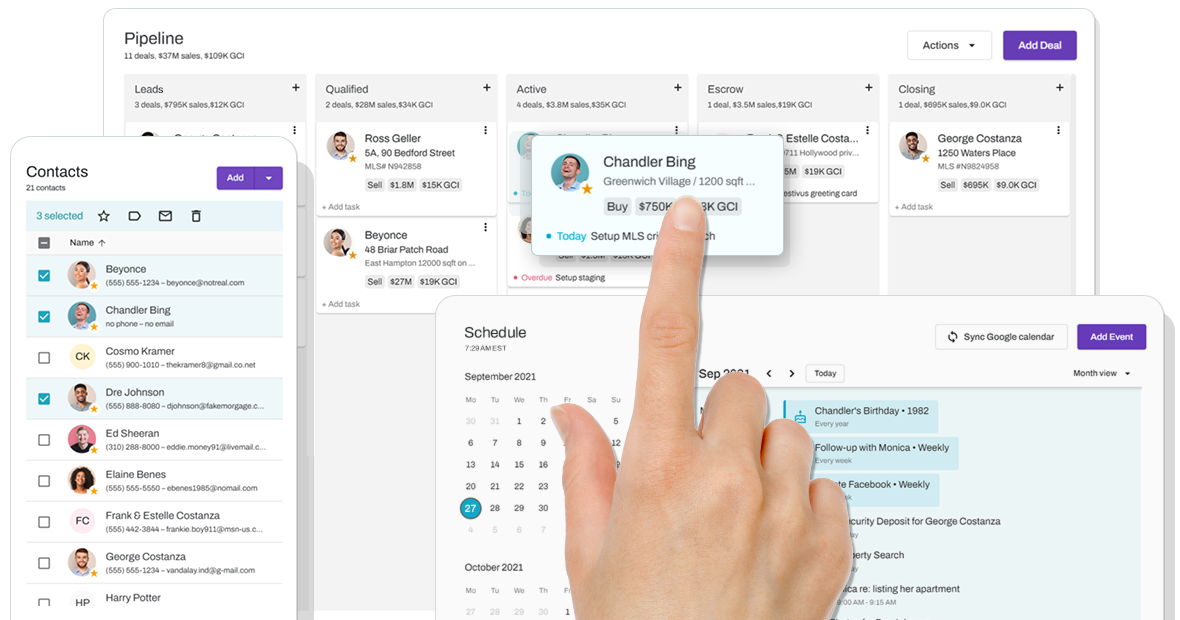
The introduction of a new CRM system can be an important step towards increasing efficiency and growth. A poorly managed transition can result in anxiety and disruption. CRM is more than an additional piece of software. It represents a fundamental shift in the management of workflows and processes. If the launch is not properly managed, it could cause low user acceptance and data chaos. It could be a waste of investment. The effectiveness of the technological upgrade is not just dependent on the features of the tool, but also on its adoption strategy. The smooth transition is dependent on carefully planned planning, clear communication and a commitment to managing change from all members of the group, right from the chief broker to the most recent agent. Following a sequence of best practices that have been tested that real estate professionals will be able to manage this transition successfully and ensure that the CRM is a useful asset from the first day. These 10 steps offer a detailed road map for a CRM adoption.
1. Define clear objectives and gain the sponsorship by your executive sponsor
The change must be supported at the top. The broker or the team leader must be the spokesperson of the transition, explaining clearly and consistently the reasons why the change is necessary. To accomplish this, you should set specific, measurable goals for CRM. Are you looking to increase lead response time by 50%? Grow your referral business by 20? Reduce administrative work by 10 hours a week? A clear set of goals creates a common space for the team and are a way to measure the success of implementation. They also ensure that everyone knows beyond the simple use of a new tool the strategic benefits.
2. Involve the team members in the process of selection from the beginning
Agents are likely to resist the idea of imposing a CRM on them without their involvement. Involve key users in the selection and demo procedure to ensure that they are fully engaged. This is true for agents who are tech-savvy as well as non-technical. They can provide valuable insight based on their first-hand encounters with the present system. When the agents have a say in deciding on the system they use and feel an appreciation for the platform and are more committed to making it work. This collaborative approach ensures that CRM selected is intuitive and addresses the issues of the team.
3. Invest in Comprehensive, Role-Specific Training
The quickest way to fail is to think that agents will "figure out" the way they're doing it. The requirement for organized and mandatory training is unavoidable. A one-size-fits all approach to training is not effective. Create separate training sessions for team leaders with a focus on pipeline management and reporting and for agents, which will focus on lead management, automation and mobile functions. Training that is hands-on is the best, using real scenarios such as import leads from Zillow and recording calls after the presentation. Create "refresher sessions" in the weeks following the launch to address any questions arising during actual usage.
4. Spend time working on a thorough Clean-Up and Data Migration
Importing old, out-of date data into your new system isn't an option. Dispose of garbage into garbage out. Before moving, spend time cleaning the database. Eliminate duplicates and information that is outdated. Sort contacts into lists that are clear. Work with your CRM provider to match old fields of data to new fields in a timely manner. A slow, methodical migration of a clean database is superior to an instant import of a chaotic list that undermines user confidence from the start.
5. Before you go full-on, begin with a pilot group
Instead of implementing the CRM for your entire office, start with a small pilot group. The group can check the workflow, spot unexpected issues, and provide feedback on the training. The group can gain from their experience. The success stories and lessons learned from the pilot group can then be used to build momentum and alleviate anxiety for others involved in the launch.
6. Standardize Workflows and document them
The power of CRM lies in the standardization. Before going live, everyone should document and agree on core workflows. For instance, what are the exact steps to process a new online lead? What drip campaign is appropriate for a newly generated buyer lead? How do you get a transaction through the pipeline phases. These clearly written guidelines help ensure that every member of the team uses the system regularly. This will help with accurate reporting and effective administration.
7. Integrate CRM with a Daily Habit
Adoption is a process that takes place gradually. Encourage agents to create the CRM as their "homepage" or their first page they open each morning. The objective is to have a single truth source. Mandate that all client communication--without exception--is logged in the CRM. Encourage clients to use personal applications for emails and notes. By concentrating all client-related activity within the CRM, it becomes the undisputed center of their business operations, and its value is immediately evident.
8. Assign CRM Champions to Maintain Support
Even with excellent instruction at the beginning There will be questions. Choose one or two tech-friendly agents or an administrative staff member to be "CRM Champions." These people receive thorough training, and serve as the primary line of support for your team. They are able to provide an internal resource that can answer quick questions. This helps reduce frustration and can also help prevent mistakes. It also lessens the burden on the broker or manager.
9. Schedule regular check ins and be sure to celebrate early successes
Implementation does not happen in one go it is a continuous process. In the initial few weeks, schedule weekly or biweekly sessions to discuss issues and share ideas, as well as reinforce the importance of the system. During these meetings, publicly highlight "wins"--such for an agent who transformed a lead following up with an automated sequence or a team who closed an agreement that was perfectly tracked in the pipeline. Positive reinforcement increases morale and also shows tangible benefits of the new process.
10. Continue to review analytics and improve usage
The job doesn't stop with the implementation. The team leader and the broker must actively use the CRM's reporting tools to track the effectiveness of the CRM and to assess its business health. Are the agents recording their activities? Leads in the pipeline are growing. Which leads convert the most? These data will help you make better business choices, and will guide your ongoing coaching. Review the goals that were set in the first step and assess progress. This method of data-driven management ensures that the CRM evolves from a mere tool to an asset that can be used strategically for growth over the long term. Follow the most popular her comment is here about best crm for realtors for more examples including pipeline sales, crm program free, crm management, ai crm, market automation, crm definition, crm data, customer relationship management software for real estate, custom crm systems, marketing for real estate and more.
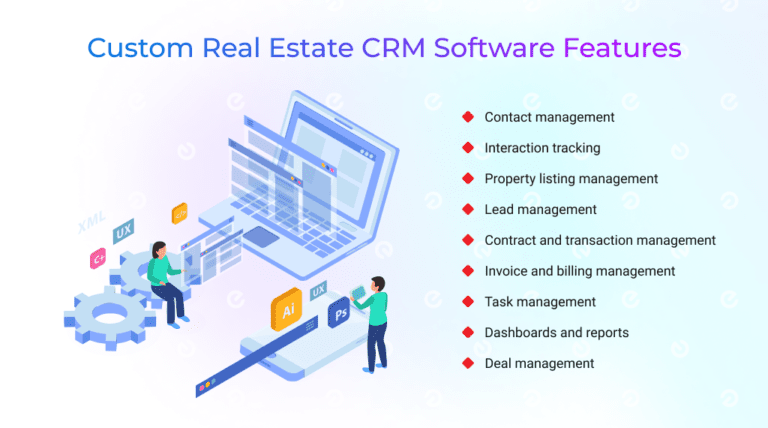
Top 10 Tips For Real Estate Crm Pricing And Roi Assessment
The cost of software called Customer Relationship Management (CRM) for the real estate sector is often a bit nebulous, since models range from affordable to large monthly investment. It is crucial for brokers and agents in the real estate industry that they understand the true price beyond the advertised cost in order to make sound financial choices. The value of a CRM is not in its price tag, but in the return on investment (ROI) it provides by boosting efficiency, higher conversion rates, and more closed transactions. A cheap system that remains unutilized is an investment in waste, while a robust system that is well-used and utilized can be able to pay for itself several times over. The process of evaluating a CRM requires a clear-eyed view of both indirect and hidden costs as well as a disciplined method for assessing the tangible business results it generates. By analyzing the different pricing structures and creating an ROI calculation framework Real estate professionals can look beyond feature comparisons and take a choice that will help fuel their growth. The following ten tips provide a detailed guide to understanding the costs of CRM for real estate and the best way to evaluate their financial return.
1. Per-User, Tiered Subscription Models (The Most Popular Structure)
CRMs for real estate are usually priced by month or an annual subscription per user, which is usually split into different levels. A monthly payment could reduce the cost for each user. The "Basics level can cover task and contact management, whereas the higher tiers can unlock sophisticated integrations, marketing tools or automatization. It is important to determine which features in the higher tiers are essential for your workflow. The price of the total is equal to the cost per user, multiplied by the number of licensed users. It's an scalable and ongoing operating expense.
2. Platform-Wide or "Unlimited Users" Flat-Rate Pricing
Certain CRMs, particularly those integrated into a larger real estate platform like KV CORE provide a flat rate pricing system. Instead of charging agents, they charge a flat-rate monthly fee to the team or brokerage that allows for unlimited users. This can be very efficient for large teams, as the price per user can be extremely low. However, it may not be a good fit for a single agent or small team because the cost per user could be significant and features are standardized throughout the company.
3. Onboarding, implementation and training costs
In most cases, the subscription is not the only cost. A lot of providers charge one-time setup fees or installation fees for establishing your system. In addition some providers provide professional onboarding as well as training. Although the basic training could be part of the program however, investing in customized deep training is advised to ensure the successful adoption. Skipping paid training in order to save money can lead to poor use, thereby reducing the CRM's worth.
4. Costs of necessary integrations with Third-Party Integrations
The cost of connecting a CRM with other software may not be included in the base cost. Often, critical integrations like the MLS direct feed, a premium marketing email service (e.g. Mailchimp Pro) as well as the VoIP phone system (e.g. Kuku.io), transaction management (e.g. Skyslope) or a VoIP call system are priced separately. To reduce the cost of additional fees it is essential to compile a comprehensive list of the integrations.
5. Limits to Database Storage and Contact Limits
Some CRM tiers have limits on the number of contacts that you can store. If you go over the limits, an upgrade to a higher-priced tier may be forced. An application that has an unlimited database of contacts is worth the price for agents with an extensive Sphere of Influence (SOI) or employ aggressive lead generation techniques. This will allow them to avoid any future restrictions and unexpected costs. Before committing, always verify the maximum number of contacts, as well as the cost for increasing the number of contacts.
6. Calculating ROI for Lead Conversion Value
Making it easier to convert leads is an easy method of calculating ROI. First, you must establish your baseline. What's your current ratio of lead-to-client conversion and how much commission do you pay per transaction. If your CRM costs $100 per month, and will help you convert just one additional lead every year, from a pool of 100 leads, and your average commission is $10k, your gross profits are $10,000. The ROI could be significant: ($10,000 - annual CRM cost of $1,200) / (1,200) = 733%. The expense can be justified by an increase in conversion rates.
7. Calculating ROI Calculating ROI Time Savings and Efficiency Gains
Time is a resource that cannot be replenished. The CRM's automation functions help you save time every week with tasks like data input, follow-up emails and even marketing. For a precise calculation, estimate the amount of time saved per week and multiply it by the desired hourly rate. If the CRM saves 5 hours per week, and you rate your time at $100/hour, that's $500/week or $2,000/month of recuperated time. This time can then be invested into activities that generate income, like lead generation and client meetings.
8. Calculating ROI - Increasing Revenues from Spheres Of Influence
The primary purpose of a CRM is to manage the care of former clients and sources of referrals. ROI is determined by an increase in revenue from repeat customers and referrals. Track the proportion of business and its value derived from your SOI. If your referral business increases by 20% because of automated birthday messages, anniversary touch and market updates this is an immediate financial gain which can be directly attributable to the CRM's ability to nurture.
9. Assessment of the "Opportunity cost" of not having a CRM
ROI isn't just about money earned; it's also about ensuring that money is not wasted. The "opportunity" price that is not being able to use CRM is the value lost from leads because of slow follow-up. This also is the case for referrals that were neglected due to a neglected SOI. Although difficult to quantify, the price is still very real. This is the reason why the CRM is a wise investment to protect against the expenses.
10. The Long-Term Worth of an Asset that is centralized
The return on investment from CRM is not just limited to the first year. A CRM that's well maintained becomes the core asset for your company. Every interaction, contact, and transaction that is completed improves the value of your CRM. The centralized information allows your business to grow, more sellable, and less dependent on a single person's memory. This long-term strategic value, though not being a line in a profit and loss report, is a critical component of building a durable and lucrative real estate company. Have a look at the best see post on best crm for real estate for blog tips including market automation, email and crm, free crm, crm and marketing, crm platform, email marketing automation software, sales crm tools, it crm tools, best crm programs for small business, top ten crm and more.